That’s a basic principle of social media. You can have a relationship with someone and never meet them face-to-face. But there’s nothing like real conversation!
 Here’s a photo of a “Tweetup” I attended this week at Panera in College Hill in east Wichita. While there was almost no talk of Twitter, there was wide-ranging discussion of social media and how it touches our lives. Fun, inform
ative, and no, we’re not all nerds. Though some of us spend a dangerous amount of time online.
This group meets most weeks at different places around town. Join us! A good excuse to get out of your pajamas and stop typing for a while.
Here’s a photo of a “Tweetup” I attended this week at Panera in College Hill in east Wichita. While there was almost no talk of Twitter, there was wide-ranging discussion of social media and how it touches our lives. Fun, inform
ative, and no, we’re not all nerds. Though some of us spend a dangerous amount of time online.
This group meets most weeks at different places around town. Join us! A good excuse to get out of your pajamas and stop typing for a while.
Author: david.kamerer@gmail.com
-
An online relationship is a real relationship
-
Vote for your favorite PR blog
 To celebrate its 10th anniversary, PR Week is holding a competition for “best PR blog.” Vote for your favorites!Of course, blogging is no competition and voting is silly. But you should definitely check out the 32 finalists – there’s some good stuff in there.As they say in Chicago, “vote early, and vote often.”
 -
It’s only an earthquake … so tweet away!
 OK, reality check time. Your house is moving. You’re inside it. Do you:
- A. Get out!
- B. Make yourself a latte
- C. Share the experience on Twitter
Ack! Angelinos chose C in large numbers, as witnessed in this wonderful interactive graph put together by the LA Times (be sure to scroll down and mouse over the graph).Personally, I’m going to grab my guitar and get out of Dodge. But my hat’s off to you, you scrappy SoCal survivors!Oh, one more thing. I guess Twitter is a mass medium, a news wire. -
Three blogs that are always worth a look
PR Squared, by Todd Defren, SHIFT Communications. Small agency that plays big, good balance between traditional PR training/technique and a solid understanding of how the Internet works.
Micro Persuasion, by Steve Rubel. He works for Edelman, a leading PR firm, and one that has positioned itself as social media-smart.seth godin’s BLOG, by, well, Seth Godin. (that’s his capitalization, not mine). More marketing oriented than above, Seth is always swinging for the fences. Sometimes he connects, sometimes he whiffs. His writing has some of the qualities of Wired Magazine, always in search of the BIG IDEA (my capitalization). There’s always a next BIG IDEA to push the old one out of view. But, having qualified his world view, he’s fearless and imaginative, and you will learn something from him.Find your own favorite social media/PR/marketing blog. Visit the Advertising Age Power 150 and toss some clicks. FYI, seth’s BLOG is ranked #1, Micro Persuasion is #9, and PR Squared comes in at #40. This week, that is. -
IRS to eBayers: the party’s over
Tucked into the housing rescue package is a provision that would require PayPal to report financial information to the Internal Revenue Service for some online merchants. Read about it in the Wall St. Journal.
 The rules change could hit millions of people who buy and sell on eBay, who, for the most part, have treated the auction site as an online garage sale. These entrepreneurs have blissfully shoved gross proceeds into their pockets and not paid income tax on them.Why does this matter? After all, for some sellers, eBay sales are legitimate income. For others, it’s just a way to get liquid, offing guitars, CDs and stereo equipment for walking around money. The IRS’ operational definition under the proposed change seems fair: you would receive a Form 1099 if you have gross sales of more than $10,000 and more than 200 transactions in a year.It’s not the creeping Big Brother-ism that bothers me. Rather, it’s creeping universal identifier. It used to be that people worried about your Social Security number being the universal identifier. That’s still part of the equation. But the real identifier is your online identity. There’s only one Internet. There’s only one you. Your behavior will follow you. And remember, Google never forgets.Social media analysts spend a great deal of time talking about your online reputation. Here’s a data point that targets your financial reputation. What’s next?Steve Jobs talks about “the cloud,” that online place where all your data reside. Of course Jobs frames it as all good, all progress. Good time to pause and think about the dark side: the unintended consequences.
 -
People first
 All these new channels – blogs, Twitter, YouTube, whatever – require some exploration to fully understand. And so begins the romancing. As we see the unique qualities of a particular tool or channel, we swoon, and become a hammer-pounder for it. Every problem gets solved with a blog, or the tool du jour.What’s a hammer pounder? You know the old maxim, “Give a kid a hammer and everything looks like a nail.”This is why basic training in strategic communication is so important. It helps you focus on achieving long-term objectives. It keeps you from being seduced by tactics. So you don’t become a hammer pounder.Take a look at this article by Josh Bernoff, co-author of the excellent book Groundswell. He advocates the POST method:
- People: assess your customers’ social activities
- Objectives: decide what you want to accomplish
- Strategy: plan for how relationships with customers will change
- Technology: decide which social technologies to use
Traditional communication training may use the term “audience.” But “people” is better. An audience is an aggregate, faceless, unknowable. But people are knowable. Since we’re engaging one person at time in unique communication transactions with social media, let’s embrace “people.”So remember, if you ever get lost in a morass of technologies and don’t know how to proceed with a communication problem, slow down. Take a breath. And remember, people first. -
Good design: more than making things pretty
Today a federal appeals court ruled that the U.S. government has an obligation to make money more accessible to people who are blind. It’s easy for Americans to just assume money has to be a certain way. But we’re pretty much alone in the world – out of 180 countries that use paper money – when it comes to making all denominations the same size and color.
As a result, it’s near impossible for a person who is blind to know which bill he or she may be spending or receiving as change.American money is ripe for redoing as an exercise in universal design. Canadian money features a handful of accessibility features, including tactile spots that work like Braille. Different denominations of Euros are different colors, and the bills increase in size as they increase in value. They’re nice looking, too.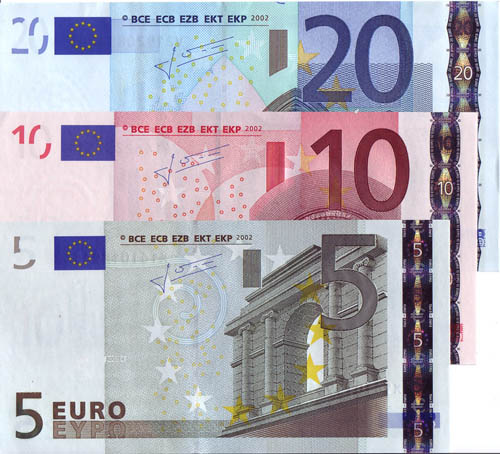
-
A quick hit of Wikinomics
Lately the “to read” stack of books by my bed table has been getting bigger. And as I fire up my RSS reader every day, I learn more and more that I know … less and less. So I was quite happy to hear Wikinomics co-author Don Tapscott on Talk of the Nation today.
I know that doesn’t excuse me from reading the book, but he represents the material in the interview quite well. While the focus is on using Wikis to enhance democracy, there’s a wide-ranging discussion of relevant social media topics. The interview is about 26 minutes long. Give a listen. -
What is a brand?
 A brand is a promise. It’s what your customers think of when they think of your company. It’s shorthand for a set of values and assumptions. It’s eternal. And it’s a moving target.Take the brand quiz, and see what people think of a handful of companies at Brandtags.net. Fun and worthwhile.Or do it backwards, smartypants. You’re such the branding expert. Guess them correctly.
 -
Writing for a new audience
I’ve done some search marketing, so the concept of writing for computers instead of humans isn’t alien to me. But I initially failed to fully realize how much public relations writing is also writing for computers.
Traditionally, the press release is written and distributed to – well, the press. But when the press release is distributed online, it goes straight to web sites, blogs, and – you guessed it – search engines. It’s classic disintermediation. Suddenly, it’s not as crucial that the New York Times picks up your story. You can get to your target audience through multiple channels. Don’t get me wrong – major media play is important. But not like it used to be.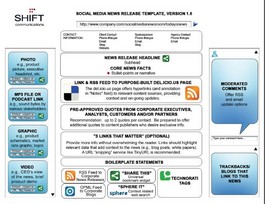 PR-Squared, the blog from Shift Communications, pioneered and popularized the social media press release, which includes lots of hooks for an interested reporter or blogger to follow. It’s like an onion. Some readers just want to peel back one layer. Others may want to peel back several. By using the tools in the social media press release, the reader can get as much or as little information as he or she needs, in the formats that are most meaningful. And all the while, you control the frame.Here are some bonus articles from PR-Squared to help you transition to PR Practitioner 2.0.