PRSA Kansas analytics presentation
Prosperity for all: lessons from Bangladesh
The great distance between America and Asia helps obscure a fundamental truth: that we enjoy cheap manufactured goods while others, including children, toil under sweatshop conditions at low wages. This was thrown into sharp relief when a factory in Bangladesh collapsed, killing more than 400 workers. Products manufactured in the factory include clothing that is likely in your closet, sold by mainstream brands like JC Penney and Gap.
We are all complicit in these deaths. We create the demand that makes the commerce possible. U.S.-based companies look the other way when they see the conditions that workers suffer under. And the manufacturers patrol their domains like gangsters, because they often are.
It doesn’t have to be that way. If we boycott the sweatshops, they will change their ways or go out of business. And we can start by becoming more mindful consumers, buying fewer but higher quality items and knowing more about their provenance.
Just 315 kilometers northwest of Savar, there’s a different kind of manufacture going on. Saidpur Enterprises is a cooperative of 21 women who sew market bags, which sell for between $58 and $78 from apolisglobal.com. This is a sort of “right-sized” capitalism, with the workers creating a high-quality product, Apolis marketing it worldwide, and consumers paying a fair price.

Apolis practices what Richard Edelman calls “profit with purpose.” Apolis “is a living and breathing social enterprise that equips and empowers people through opportunity. Apolis is a pioneer in the socially responsible apparel industry and creates opportunity by forming unique manufacturing partnerships around the globe.” The company is not a non-profit. Instead, it is a “B Corporation,” an innovative structure that balances good business with social purpose. Success, for a B Corporation, is much more than just making money. Also part of the rubric: governance, workers, community and environment. B Corporations also practice transparency, sharing their progress for all the world to see (view Apolis’ scorecard here).
Apolis is one company riding a crest of public support for ethical business practices. In 2012, Edelman updated the “Good Purpose” study, a six-year longitudinal study that has documented this trend. The study found:
- a 47 percent increase over 2010 in consumers who bought a cause-related brand monthly;
- a 39 percent increase in willingness to recommend cause-related brands;
- a majority feel that CEOs should be leaders in creating socially-responsible practices.
Adding purpose to a company’s mission can turn out to be good business. It certainly can help improve the quality of life for the workers who make the products that we buy.
And it’s certainly something to think about in the attention economy, in which advertising no longer works and companies have resorted to shouting to be heard. Instead: invest in performance, deputize your stakeholders, and let them tell your story. People will listen to that.
When owned and social media collide – the case of the Nokia Lumia 620
 Ah, it used to be so simple. Journalists were people who published news and information. And they abided by a code that we all understood. Independence. Editorial oversight. Objectivity.
Today, of course, that model is dead, dead, dead. Anyone can publish. But “journalistic” structures often carry some vestigal ethos from real journalism, simply by using the same structure and formatting. The web is full of this kind of almost-journalism.
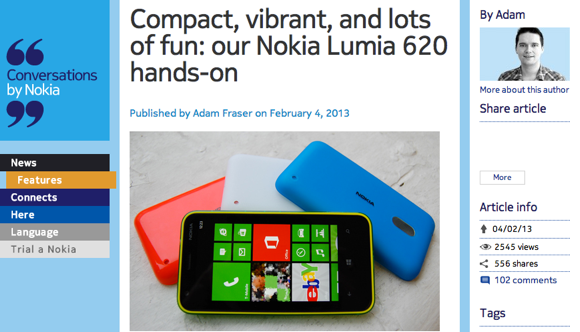
Nokia published a review of its new Lumia 620 phone on the “Conversations by Nokia” blog. And guess what? They liked it! They REALLY LIKED IT.
The headline calls the phone “compact, vibrant, and lots of fun.” And then come the accolades:
“it’s clear to see that the Nokia Lumia 620 is a fun, almost-youthful smartphone, thanks to the new colour range.”
“The dual-core 1GHz Snapdragon CPU does a fantastic job at keeping everything running as smooth as any other – more expensive – smartphone.”
“If you’re into your music, you’ll be happy to know that the Nokia Lumia 620 plays it loud; at about 100db we believe. Perfect for listening to you favourite bands using Nokia Music.”
Gizmodo, AdWeek, Digiday and others had a field day with this puff piece. Giz wrote a parody review, including this bit of snark:
“The post is designed to be read as an expert review of a smartphone, aimed at helping consumers make informed purchasing decisions. It contains ample Nokia fawning cloaked in your standard gadget writer tropes, so it’s easy to confuse this public relations flackery as a real review.”
It’s instructive to read the comments on the original article. A plurality of commenters blast Nokia for publishing a deceitful article. But many others defend the company, saying of course they can write about their own product.
The takeway? The rhetorical principle at play here is ethos – the reputation of the communicator. By playing fast and loose with reader expectations, Nokia undermined its credibility. It’s essential to practice radical transparency. You’re doing yourself no good if you deceive even one reader. So, dispense with the phony review voice, clearly label third party content, and tell your story. Owned media is a powerful, often underutilized channel. Give me detailed specifications, comparisons with competing products, and detailed photos, the more the better.
Simultaneously, Nokia could also engage the social space in an ethical, open manner. Here are some things the company could legitimately do:
- Publish links to third party reviews
- Create a microsite for the product, encouraging reviews
- Create opportunities for bloggers or ordinary people to try the phone
- Lend review samples to influencers (with disclosure)
- Encourage owners to share their experiences with the phone in a wiki
- Encourage tagging of photos taken with the phone on Instagram
It doesn’t take a lot of imagination to encourage or curate social conversations about the phone. There is a catch, however: Nokia will have to respect the sentiment of the conversations. If the phone stinks, people are going to say so.
Since the social drubbing started, Nokia rewrote the headline, stating at the end of the article:
“Note: This article was first headlined as a ‘review’, obviously, it’s more of a hands-on account of Adam’s experiences and the headline has been changed to reflect that.”
Not enough. Nokia should apologize for confusing the people who read the review. And they should take it down. This is social media at its worst – people are talking, but they’re not talking about the phone. And they’re bashing your brand. Lose/lose.
Postscript: the blogger’s defense
Here’s a conversation on Twitter between Gizmodo’s Mario Aguilar and review author Adam Fraser:
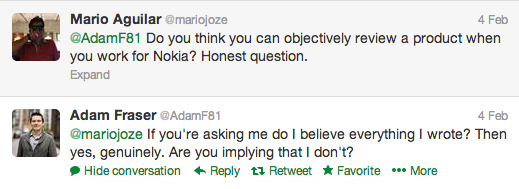
This sort of “statement of independence” is common in the world of the paid blogger. The author can state it repeatedly. It may be true. But it carries no credibility. The independence statement is overwhelmed by the economic arrangement.
Corruption of digital discourse (slide deck)
Improve your digital listening skills
 Of all the benefits of social media for business, the greatest come from listening. Consider this: you can listen unobtrusively – no one needs to know you’re paying attention. You don’t even need to sign up for accounts to listen. This is a great place for the socially-shy business to dip its toes into social media. After you’ve observed some success from listening, it’s also easier to make the case to senior management for social engagement.
Here are some tips to help you improve your ability to monitor the online chatter:
1. Get right with Google. You might use Google and other search engines regularly, but you’re probably not making best use of advanced features. Not everyone knows the basics of Google. It’s common to do a search and get millions of results. But you’d be better off getting fewer, but more relevant, results. Your overall goal is to improve your “signal to noise” ratio. So learn these basic tips:
- Put the exact search term in quotes, such as “Bob Jones University” to eliminate spurious results when using common words
- Use the “site” operator to restrict your search to only one website, such as “Form 990 site:irs.gov”
- Use Boolean operators, such as OR, as in “Bob OR Bobby Knight”
- The exclude operator ( – ) eliminates specified words: “Bob Dylan young -forever” eliminates references to the song “Forever Young” from your results
2. Use Google Alerts. (This service requires a Google account). Use Alerts to track mentions of your name, your company or your senior executives. As your alerts come in, you may find that you need to fine-tune your mix using the techniques above. You should also be a contrarian – be sure to monitor keywords that reflect your business category and your competition. It’s best to set your alerts to show up in your RSS feed rather than via email. Then monitor the feed regularly.
3. Set up your RSS feeds. Some say RSS is in decline, in part due to “black box” technologies that don’t include RSS and in part due to the rise of social sharing. But you can’t count on social sharing when there’s a cost associated with missing important news. RSS is a powerful way to aggregate most of your listening in one place. The most common RSS listening client is Google Reader (requires a Google account). But once your feeds are running in Reader, you can monitor them using other clients by syncing the feed (on iOS devices you might try NetNewsWire or Reeder).
Some argue that it’s too much work to set up and monitor RSS feeds. But if you’re a high-volume consumer of news and information, it’s too much work NOT to use RSS.
4. Use Twitter Advanced Search. The best way to find out what’s happening now is on Twitter, the beating heart of the real-time web. The next time a popular live event is on television, see this for yourself. As you watch the show, follow the most likely hashtag (or search term) on Twitter. Note the volume of tweets. Observe the tone of the comments. People on Twitter don’t hold back – if you’re watching the Oscars, you’ll get detailed feedback on every dress and performance.
The real money comes from the advanced search page (using “advanced search” pays dividends on almost every search). With advanced search, you can specify a location, very useful, say, if you’re a local chapter of a national nonprofit. Or, you could track response to a political speech in different regions. You can also search multiple keywords in one search and use other tools for a more tailored search.
Unfortunately, Twitter no longer publishes RSS as part of its API, so you’ll have to do this manually or use a workaround unless you subscribe to a premium service such as Salesforce Radian6.
5. Remember, you are the analyst. It’s your job to process a mountain of data, sift it, and then find the few insights that are worthy of action. Sometimes there’s no substitute for intelligence and experience. Some terms don’t search cleanly, so you’ll have to find ways to throw out the irrelevant results. Sentiment filters are notoriously unreliable. So never forget: you’re in charge.
Remember also that the Internet never sleeps. If you’re working for a national brand, or for a smaller brand in the news, you need to monitor constantly. Online, a crisis can blow up in minutes. And when something good happens, you’ll want to capitalize on it.
6. Listening doesn’t always require action. It’s good to remember that you can’t please everybody. Some critics fall below the noise floor. But when an influencer is talking about your brand, good or bad, you need to pay attention. These tools will help you get started. If the scope of listening or budget allows, you might graduate to a paid service, such as Sprout Social or Salesforce Radian6. These tools are not only more powerful, they also include dashboards so a manager can delegate jobs and create activity reports.
PRSA Chicago slide deck on disclosure of material connections
Here is my slide deck from my presentation in Chicago on July 20. Thanks for attending!
PRSA International Conference – downloads
Here are some files I’m sharing at the PRSA International Conference:
Analytics and campaign development – Analytics and campaign development
Research summary – PDF; PR at the micro level summary
Teaching poster – PDF; media relations for the digital age
Detailed notes – PDF; creating the digital press release
How to handle job layoffs
This morning brought news of a layoff of 500 at Hawker Beechcraft, even though the company has has backlog of more than $7 billion. It’s a necessary, strategic adjustment, and for some employees, it’s going to hurt like hell. Kudos to CEO Jim Schuster for clearly and honestly telling the company’s story.

The company is preparing for a serious economic storm. According to a letter to employees written by Schuster, quoted in an article by Molly McMillin in the Wichita Eagle, it’s time to act on “long overdue talent upgrade actions – we have no room for underachievers, particularly in these difficult times.” HBC will also defer capital spending, build cash reserves, reduce inventory and scale back forecasts.
Shel Holtz offers nine tips for handling job layoffs on his blog. It’s the job every PR professional dreads. But one of the themes of effective public relations practice is to focus on long-term success, and communicating bad news is part of the job. It’s no time for a pity party; the focus should be on the good of the enterprise, says Holtz.
It’s easy to take good times for granted, in our lives or in business. Whether it’s stocks or real estate values, we quietly accept prosperity, but become outraged when the economy tanks. So take note: the pendulum will swing both ways.
In a letter written by Schuster, quoted in the Wichita Eagle, “Never again are we likely to face circumstances quite like those we face today. Never again are we likely to have the platform on which to drive change and build value.
“I have always believed that great companies come to life when times are most challenging – ladies and gentlemen, you are the team, and this is the time.”
Good work by the HBC senior management and communication team. While there’s nothing wrong with hoping for the best, it’s the company’s obligation to prepare for the worst.