Corruption resources (PDF document with links)
Associate Professor of Communication, Loyola University Chicago
Corruption resources (PDF document with links)
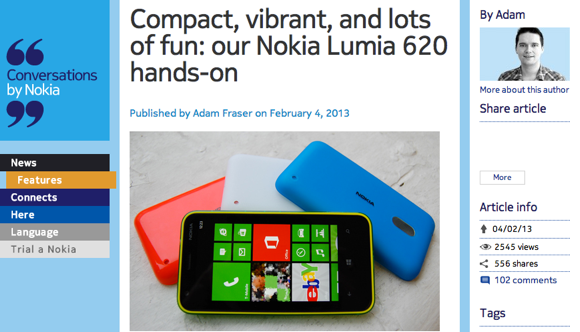 Ah, it used to be so simple. Journalists were people who published news and information. And they abided by a code that we all understood. Independence. Editorial oversight. Objectivity.
Today, of course, that model is dead, dead, dead. Anyone can publish. But “journalistic” structures often carry some vestigal ethos from real journalism, simply by using the same structure and formatting. The web is full of this kind of almost-journalism.
Nokia published a review of its new Lumia 620 phone on the “Conversations by Nokia” blog. And guess what? They liked it! They REALLY LIKED IT.
The headline calls the phone “compact, vibrant, and lots of fun.” And then come the accolades:
“it’s clear to see that the Nokia Lumia 620 is a fun, almost-youthful smartphone, thanks to the new colour range.”
“The dual-core 1GHz Snapdragon CPU does a fantastic job at keeping everything running as smooth as any other – more expensive – smartphone.”
“If you’re into your music, you’ll be happy to know that the Nokia Lumia 620 plays it loud; at about 100db we believe. Perfect for listening to you favourite bands using Nokia Music.”
Gizmodo, AdWeek, Digiday and others had a field day with this puff piece. Giz wrote a parody review, including this bit of snark:
“The post is designed to be read as an expert review of a smartphone, aimed at helping consumers make informed purchasing decisions. It contains ample Nokia fawning cloaked in your standard gadget writer tropes, so it’s easy to confuse this public relations flackery as a real review.”
It’s instructive to read the comments on the original article. A plurality of commenters blast Nokia for publishing a deceitful article. But many others defend the company, saying of course they can write about their own product.
The takeway? The rhetorical principle at play here is ethos – the reputation of the communicator. By playing fast and loose with reader expectations, Nokia undermined its credibility. It’s essential to practice radical transparency. You’re doing yourself no good if you deceive even one reader. So, dispense with the phony review voice, clearly label third party content, and tell your story. Owned media is a powerful, often underutilized channel. Give me detailed specifications, comparisons with competing products, and detailed photos, the more the better.
Simultaneously, Nokia could also engage the social space in an ethical, open manner. Here are some things the company could legitimately do:
It doesn’t take a lot of imagination to encourage or curate social conversations about the phone. There is a catch, however: Nokia will have to respect the sentiment of the conversations. If the phone stinks, people are going to say so.
Since the social drubbing started, Nokia rewrote the headline, stating at the end of the article:
“Note: This article was first headlined as a ‘review’, obviously, it’s more of a hands-on account of Adam’s experiences and the headline has been changed to reflect that.”
Not enough. Nokia should apologize for confusing the people who read the review. And they should take it down. This is social media at its worst – people are talking, but they’re not talking about the phone. And they’re bashing your brand. Lose/lose.
Postscript: the blogger’s defense
Here’s a conversation on Twitter between Gizmodo’s Mario Aguilar and review author Adam Fraser:
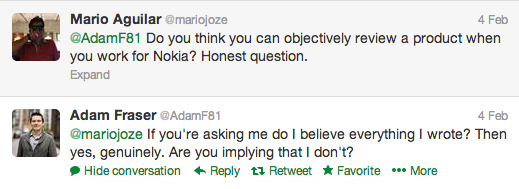
This sort of “statement of independence” is common in the world of the paid blogger. The author can state it repeatedly. It may be true. But it carries no credibility. The independence statement is overwhelmed by the economic arrangement.
Here is my slide deck from my presentation in Chicago on July 20. Thanks for attending!
If you’re writing a blog or social media post and have received free product, services or enjoy a business relationship, you need to disclose it to your readers. Face it; you write for them and they deserve to know. It’s also the law, as the Federal Trade Commission has issued clear instructions on what constitutes a material connection and how you should disclose it.
Disclosure is actually pretty easy. If you received something of value, tell your readers. Right there in the post. If in doubt, disclose anyway. If you just do that, you’ll be fine. But there are some other things you can do to fully inform your readers and stay on the right side of the law.
A site disclosure statement
In general, your disclosures should be presented with the relevant content. If you’re reviewing a new automobile and a local dealer gave you the car to drive for two weeks for free, you should disclose that within your review.
But you may find it useful to write a general disclosure statement as well. You can place this on its own page or on an “about” page. This is your chance to tell your readers – and potential sponsors or affiliates – about your personal “rules of the road,” such any long-term financial relationships you have. If you accept product or services for review, you can explain your process and what the sponsor can expect. For example, in this space you may reserve the right to write a negative review, or you can explain your policy for a sponsor’s rebuttal of your review.
Your disclosure statement doesn’t need to be long or complicated. Here are some examples of site-wide disclosure pages:
Blog with Integrity
At Blogwithintegrity.com, a handful of bloggers approach self-regulation for the online community, offering a broad set of good practice standards. Bloggers may “sign the pledge” electronically and then display the “Blog with Integrity” badge on their websites as a seal of good practice.
Here’s what the pledge says:
By displaying the Blog with Integrity badge or signing the pledge, I assert that the trust of my readers and the blogging community is important to me.
I treat others respectfully, attacking ideas and not people. I also welcome respectful disagreement with my own ideas.
I believe in intellectual property rights, providing links, citing sources, and crediting inspiration where appropriate.
I disclose my material relationships, policies and business practices. My readers will know the difference between editorial, advertorial, and advertising, should I choose to have it. If I do sponsored or paid posts, they are clearly marked.
When collaborating with marketers and PR professionals, I handle myself professionally and abide by basic journalistic standards.
I always present my honest opinions to the best of my ability.
I own my words. Even if I occasionally have to eat them.
Blog With Integrity was created by Susan Getgood, Liz Gumbinner, Kristen Chase and Julie Marsh, each a blogger. It’s unclear if Blog With Integrity is a non-profit, a business, or a service project that reflects the partners’ personal interests.
Cmp.ly

The cmp.ly badge clearly shows material connections on your blog.
Cmp.ly is an online service that explicitly addresses the FTC’s material disclosure rules. It offers a simple and direct way for a blogger to disclose specific kinds of relationships. Because the cmp.ly tags are short, they’re appropriate for micro channels such as Twitter and Facebook. The service is free for individuals, with payment options for enterprise-level applications.
To use the service, simply select and post the tag that reflects your specific material connection (click the links to see the badge and language for each):
Cmp.ly/0 no material connection
Cmp.ly/1 review copy
Cmp.ly/2 sample or gift
Cmp.ly/3 paid post
Cmp.ly/4 business relationship
Cmp.ly/5 affiliate program
Cmp.ly/6 is reserved for custom disclosures that don’t fit the above categories.
While cmp.ly covers the main categories of material relationships, it doesn’t provide specific information about them. So if you’re writing about four zoom lenses but have a relationship with one brand, it doesn’t offer any precision to guide the reader.
The FTC has stated that simply putting a button on a post that says “disclosure” with a link to the disclosure policy isn’t adequate. This suggests that the best use of cmp.ly is in micro-channels, where the compact disclosure would fit.
An alternative to cmp.ly for micro channels, also suggested by the FTC, are hashtags such as #ad, #paid, or #paid ad.
