Category: blogging

  • When owned and social media collide – the case of the Nokia Lumia 620

    Ah, it used to be so simple. Journalists were people who published news and information. And they abided by a code that we all understood. Independence. Editorial oversight. Objectivity.

    Today, of course, that model is dead, dead, dead. Anyone can publish. But “journalistic” structures often carry some vestigal ethos from real journalism, simply by using the same structure and formatting. The web is full of this kind of almost-journalism.

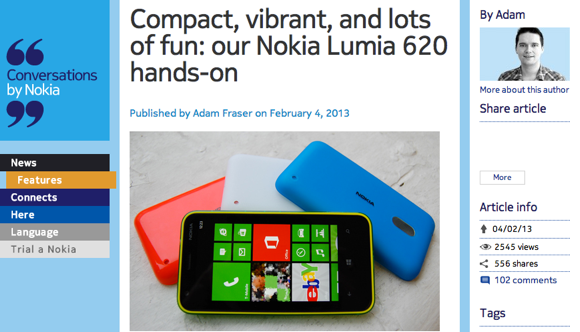
    Nokia published a review of its new Lumia 620 phone on the “Conversations by Nokia” blog. And guess what? They liked it! They REALLY LIKED IT.

    The headline calls the phone “compact, vibrant, and lots of fun.” And then come the accolades:

    “it’s clear to see that the Nokia Lumia 620 is a fun, almost-youthful smartphone, thanks to the new colour range.”

    “The dual-core 1GHz Snapdragon CPU does a fantastic job at keeping everything running as smooth as any other – more expensive – smartphone.”

    “If you’re into your music, you’ll be happy to know that the Nokia Lumia 620 plays it loud; at about 100db we believe. Perfect for listening to you favourite bands using Nokia Music.”

    Gizmodo, AdWeek, Digiday and others had a field day with this puff piece. Giz wrote a parody review, including this bit of snark:

    “The post is designed to be read as an expert review of a smartphone, aimed at helping consumers make informed purchasing decisions. It contains ample Nokia fawning cloaked in your standard gadget writer tropes, so it’s easy to confuse this public relations flackery as a real review.”

    It’s instructive to read the comments on the original article. A plurality of commenters blast Nokia for publishing a deceitful article. But many others defend the company, saying of course they can  write about their own product.

    The takeway? The rhetorical principle at play here is ethos – the reputation of the communicator. By playing fast and loose with reader expectations, Nokia undermined its credibility. It’s essential to practice radical transparency. You’re doing yourself no good if you deceive even one reader. So, dispense with the phony review voice, clearly label third party content, and tell your story. Owned media is a powerful, often underutilized channel. Give me detailed specifications, comparisons with competing products, and detailed photos, the more the better.

    Simultaneously, Nokia could also engage the social space in an ethical, open manner. Here are some things the company could legitimately do:

    • Publish links to third party reviews
    • Create a microsite for the product, encouraging reviews
    • Create opportunities for bloggers or ordinary people to try the phone
    • Lend review samples to influencers (with disclosure)
    • Encourage owners to share their experiences with the phone in a wiki
    • Encourage tagging of photos taken with the phone on Instagram

    It doesn’t take a lot of imagination to encourage or curate social conversations about the phone. There is a catch, however: Nokia will have to respect the sentiment of the conversations. If the phone stinks, people are going to say so.

    Since the social drubbing started, Nokia rewrote the headline, stating at the end of the article:

    “Note: This article was first headlined as a ‘review’, obviously, it’s more of a hands-on account of Adam’s experiences and the headline has been changed to reflect that.”

    Not enough. Nokia should apologize for confusing the people who read the review. And they should take it down. This is social media at its worst – people are talking, but they’re not talking about the phone. And they’re bashing your brand. Lose/lose.

    Postscript: the blogger’s defense

    Here’s a conversation on Twitter between Gizmodo’s Mario Aguilar and review author Adam Fraser:
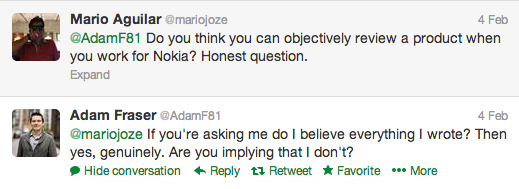
     

    This sort of “statement of independence” is common in the world of the paid blogger. The author can state it repeatedly. It may be true. But it carries no credibility. The independence statement is overwhelmed by the economic arrangement.
  • Send a note to Google with the “Rel=author” tag

    Note: As of September, 2014, Google no longer supports Google Authorship.

    When I talk to students about personal branding, the process is pretty simple: be findable online. Try to own the first page of Google results for your name. And show your special interests and skills in that space.

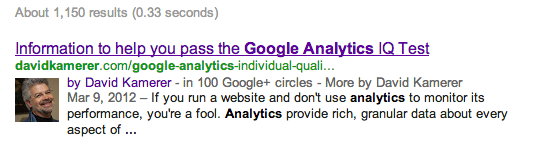
    Google’s new “rel=author” tag is a new tool that enhances this personal branding effort. When properly implemented, your avatar will be listed in a search engine results page (SERP) along with a link to other content that you’ve authored and a link to your Google+ account. It’s a nice way to stand out.

    Here’s what it looks like:

    Google Authorship example


    To implement Google Authorship, first you’ll need a Google+ account.  Fill out your profile page completely and carefully. This page functions as your “about” page in the Google universe. I recommend that you complete this step even if you are not committed to the Google+ platform. If you want to see an example, take a look at my Google+ profile page.

    Next, on the “Contributor to” tab, list your website and other places where you publish. Finally, link back to your Google+ profile on your website.

    For detailed implementation instructions, look at Andy Crestodina’s post or Rick DeJarnette’s instructions. Remember that your authorship may not show until the next time Google crawls your site.

    More resources:

  • PRSA Chicago slide deck on disclosure of material connections

    Here is my slide deck from my presentation in Chicago on July 20. Thanks for attending!


  • Respecting copyright on your blog or social media page

    copyright.gifIt’s a new semester, and that means students everywhere are jumping in to digital publishing, either for fun, self-expression or as part of a classroom assignment.

    While student work may seem to have limited scope, at some level it’s no different from a page at nytimes.com. If it’s published online, it is a public document and can potentially reach a worldwide audience. So it’s essential that students respect copyright.
    The bulletproof way to avoid copyright liability is to create all the information yourself. Your words, your images. If you’re writing a blog post, shoot your own photo or create your own illustration.
    But there are sources of images that you can use and avoid copyright liability. You can search the Wikipedia Commons for an appropriate image. The terms of use are generous, but not unlimited, so be sure to read the guidelines for use
    Under Section 105 of Title 17, which covers copyright law, the United States government does not hold copyrights, so you can generally use images from government websites. 
    Copyright has a “safety valve” called Fair Use, which allows people to incorporate copyrighted works into other works. This allows a book reviewer to reproduce a passage from a novel, for example. But be careful – the boundaries of fair use are uncertain. Case law only provides a set of general principles, which include: purpose and character of the use; nature of the copied work; amount and substantiality of the use; and the effect upon the work’s value.
    A newer concept for protecting intellectual property rights while accepting that we live in a “Remix” culture is the Creative Commons License. Under this model, online content can be shared under conditions that the author permits. For example, you might be able to use someone else’s photograph on your blog, provided that you credit the source and link back to the original. You can learn more about finding licensed work on the Creative Commons website. The photo sharing site Flickr has a “Creative Commons” filter on its advanced search page to help you find sharable images. 
    In the end, no matter the source of your words, sounds and images, responsibility for their legal and appropriate use is yours. So inform yourself, and choose wisely. This prudent practice will also help you avoid trouble when you’re creating messages for an employer.
    Additional resources to help locate copyright-free images: