Here are videos that explain what you need to know about YouTube SEO and YouTube annotations.
ICA presentation – disclosure of material connections
Information overload presentation to ASJMC
Find links to resources in this presentation at delicious.com.
Chicago concerts during AEJMC
Coming to Chicago for AEJMC? You may want to purchase advance tickets for an important show. Here are some highlighted touring musical events in Chicago during the Association for Education in Journalism and Mass Communication (AEJMC):
August 7-8. Coldplay, with Marina & the Diamonds and Emeli Sande. United Center. Ticket information. Location/transit info.
August 8. Rufus Wainwright. Bank of America Theatre. Ticket information. Walking distance from convention hotel.
August 10. Joe Cocker with Huey Lewis & the News. Ravinia Festival, Chicago’s outdoor “shed” venue. Ticket information. Location: Highland Park, IL. While Ravinia is about an hour away, it’s fun to go. Three special Metra trains go directly to Ravinia Park on weekdays. These trains are on the Union Pacific North Line and depart from Ogilvie Transportation Center, which is about a block north of Union Station. The Ravinia trains are $7 for the round trip and depart Ogilvie Center at 5:50 p.m., 6:00 p.m. and 6:44 p.m. Get off at Ravinia Park. Note: people often pack picnic dinners to take to Ravinia, but you can also purchase food and drink at the park.
August 10. Taj Mahal Trio. Old Town School of Folk Music. Ticket information. Location: Lincoln Square neighborhood. Directions: take Red line CTA train north to Belmont, transfer to Brown Line train to Western. Walk three blocks south on Lincoln.
August 11-12. Train with Mat Kearney. Ravinia Festival. Location: Highland Park, IL. Ticket information. The Ravinia train leaves Ogilvie Center at 5:35 p.m.
August 12. George Thorogood & The Destroyers with Tom Hambridge. House of Blues, 329 N. Dearborn. This venue is walking distance to the convention. Ticket information.
check current concerts at pollstar.com
Look for information on music clubs, restaurants and theatre events in future posts.
Digital tools for travel
“In this country, you gotta get the power first. Then when you get the power, you get the wi-fi. Then when you get the wi-fi, then you get the work done.” (if Scarface was made today)
Everyone has a special routine for travel. Here’s mine, with a focus on getting the most from your digital devices:
 There’s no reason to travel without full information; this is probably the most essential tip I can offer. I really like FlightTrack Pro (about $10) for this job. Input your flight information, and FlightTrack keeps track of it. This includes gate changes, late departures and layovers. If your flight is cancelled, all the phone numbers you need are right there. You can text or email your flight data to waiting parties, too.
When you travel you really rely upon and use your phone, so I always carry charging cables and a spare battery. Mine is a Duracell USB Instant Charger, (about $20). It’s small, yet offers up to 180 extra minutes of talk time on your iPhone.
At the airport, your huddled masses yearning to power their digital devices are easily identified. Rather than re-enacting a scene from Road Warrior, make peace with this tribe with the Monster Power to Go mini power strip. It’s compact and relatively flat so you can stuff it into your computer bag. Mine has three AC outlets plus USB power for an iDevice. Also recommended for the live-tweeting nerd rodeo at social media events. When you get to your hotel room, the strip will help you keep all your equipment together and charged.
 In the air, it’s nice to create some psychological distance from the many other passengers. Ditch those cheap earbuds that came with your iPod. You’ve got two kinds of solutions for air travel: isolation earbuds or noise-cancelling headphones. I’ve gone the isolation route. My Etymotic ER6i phones use a triple-flange to seal out the crying babies and chatty seatmates (alternate tip: tell your seatmate you’re an undertaker). Some people don’t like the feeling an object deep in your ear canal, but it doesn’t bother me. The Etymotics also sound terrific, and because the noise is sealed out, you don’t have to crank your volume so high, so you also conserve your batteries. If you hate the idea of something in your ears, try noise-cancelling headphones instead. These use an active circuit to “listen” to the noise, then manipulate the phase of the audio signal to try to eliminate it. The most popular model seems to be the Bose Quiet Comfort, but they’re expensive. If you’re in the market, the experts at headphone.com round up the best (at all price points) of in-ear and noise-cancelling phones for you.
Before you depart, download content for the trip. You can’t really use streaming services like Netflix or Hulu while in the air. I like podcasts from National Public Radio, such as Fresh Air. If you use an iPad, the digital magazines from Conde Nast (Wired, New Yorker, Vanity Fair, GQ) as well as Amazon Kindle books are all readable with no Internet connection. If you’re a voracious web reader, clip your articles in advance with Instapaper for offline reading later.
Sometimes the trips are fast and smooth; sometimes you’ll spend eight hours at O’Hare and then they’ll send you back home. The basic plan for me is to prepare, pack the essentials, but also to travel light.
What’s in your essential travel kit? Leave your picks in the comments.
Three trends for today
Name your own price
Radiohead did it with their album In Rainbows; Louis CK did it with his Live at the Beacon performance video, and now Panera is experimenting with the model in its CSR initiative, Panera Cares. If you let your customers name their own price, will they pay? What principles govern this model? Three experts kick it around in this Chicago Tribune article.
A new entrant in the daily deal space
Daily Deal sites like Groupon have focused on building reach. SaveLocal, a new service from outbound email service provider Constant Contact has created an affinity program to reward existing customers, increase the purchase cycle, and empower small merchants to compete. Interview with Constant Contact CEO Gail F. Goodman in the New York Times. (paywall)
Sidebar: Two merchants consider their experience with Groupon, Living Social and SaveLocal.
Mobile payments heat up

This credit card terminal at Macy's is also equipped with Google Wallet, an NFC-based form of mobile payment.
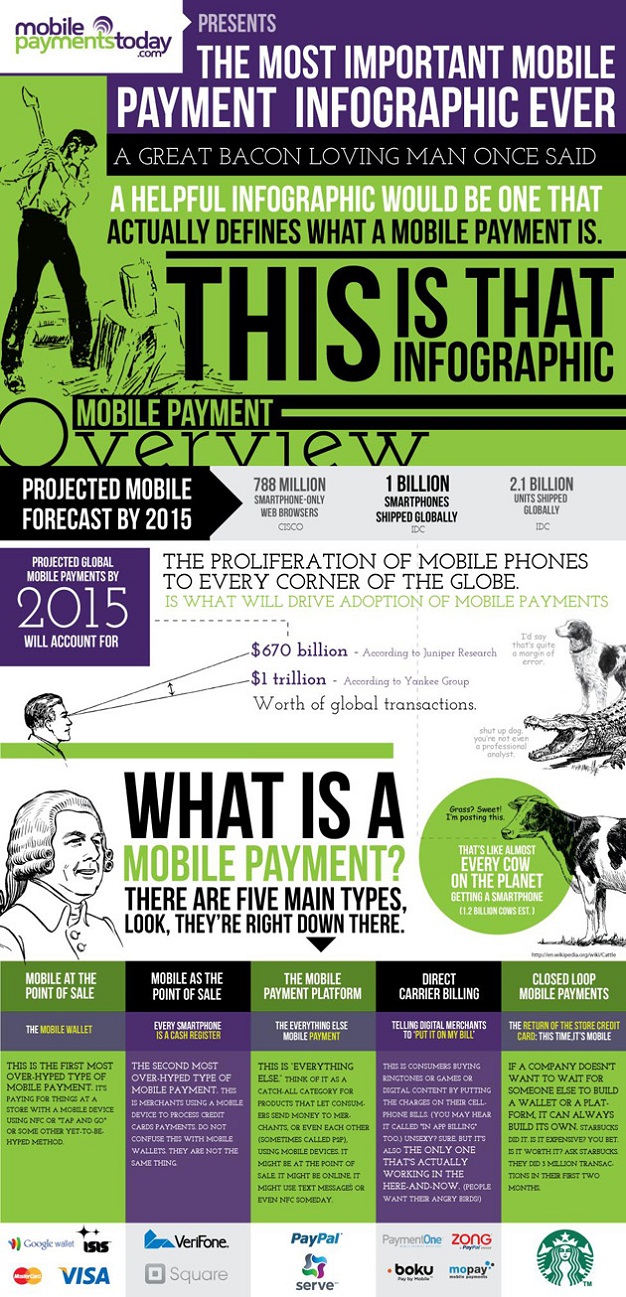
This week PayPal announced its entry into the mobile payments area, with a triangular smartphone attachment very similar to the Square Payment Service. This is one of several mobile payment models, the smartphone as cash register. (see infographic below for the other four flavors). What’s at stake? More than 2.7 percent of all transactions in a rapidly growing market. Today we have a plurality of ways to pay with a mobile device, but I expect there will be a shakeout as the big boys (Visa and MasterCard) get things sorted out. Meanwhile, Starbucks continues to go its own way with a smartphone-linked app that uses bar codes to link your Starbucks card to your mobile device.
Sidebar: Jonathan Stark used Twitter and his Starbucks card to share coffee with complete strangers. It was a sort of “leave a penny, take a penny” for the wired set. The experiment hummed along for awhile until Starbucks shut it down last summer.
Google Analytics Individual Qualification (IQ) Test preparation
If you run a website and don’t use analytics to monitor its performance, you’re a fool. Analytics provide rich, granular data about every aspect of your site and how it performs. Without this information, you can’t meaningfully improve your site – or justify the resources needed to run the site to your boss or board of directors.
Because of the depth of information available from analytics, it’s essential that you go beyond the standard default reports. You may also need to modify your code to track downloads or ecommerce. You may also want to segment your reports (only visitors from Illinois or exclude employee use of the website, etc.). You need to be able to peel back the layers of this powerful tool.
One way to make sure you’re learning the depth and breadth of the tool is to seek certification, the Google Analytics IQ exam. Pass it and you’ve got a credential that distinguishes you from the other so-called digital “experts.”
Here are some resources to help you better understand Google Analytics, whether your goal is to pass the competition or simply to pass the test. I recommend you work through this material in conjunction with using Google Analytics (at the “administrator” level) for a client.
Test strategy
Evan Fazio’s recommendations. Evan is a student of mine who took the test. He offers strategies for making the most of the time allotted (90 minutes).
How to pass the Google Analytics IQ test, guide from Slingshot SEO in Indianapolis. Other great Google Analytics and SEO resources available on this page, too. Includes some useful regex statements you can copy and repurpose.
The Rise guide to passing the Google Analytics exam, from Rise Interactive in Chicago. Excellent multi-part guide, free downloads.
SEOmoz article on how to pass the GAIQ test.
Jens Sorensen’s advice on how to pass the GAIQ test
Jens Sorensen’s online notes (use CTR-F to find relevant text strings on this long page)
Books
Advanced Web Metrics with Google Analytics, by Brian Clifton (third edition forthcoming.) Previous editions have come with a $25 voucher for taking the Google Analytics IQ test (full cost to take the test is $50). Clifton is a former Google employee.
Web Analytics: an hour a day, by Avinash Kaushik. Avinash works for Google
Web Analytics 2.0: the art of online accountability and science of customer centricity. This is Avinash’s newer book.
Web resources
Occam’s Razor, Avinash Kaushik’s excellent analytics blog.
Google Analytics home page. Especially useful: Support and Education tabs.
Filter IPs with this Regex calculator from Google.
Videos
Conversion University. This is Google’s set of videos, which are essential to study. Just a couple of notes: they mostly reflect the old version of analytics, and some of the audio is missing. If there is no sound, click on the notes tab to see the text.
Lynda.com offers a complete set of videos on Google Analytics. Access to the entire Lynda site, which features many great instructional videos of interest to designers, videographers and digital marketers, begins at $25/month.
Loyola Ad Club Digital Roundtable
It’s my pleasure to join a group of top ad professionals for a roundtable on trends in digital advertising:
hashtag #LoyolaDigital 5 p.m. Thursday, March 1Corboy Hall Room 105 25 E Pearson, Chicago, IL 60611 (southwest corner of Pearson & Wabash)
Featuring:
- Kristin Scheve, Media Supervisor, Digitas
- Jonathan Sackett, EVP, Chief Digital Officer/Managing Director, DDB
- John Doyle, VP Strategy Director, Interactive CK
- Brian Mandelbaum, President and CEO, Clearstream Video
- Michael Gallo, CEO & President, Chicago Interactive Group
Please come out to meet Loyola advertising students and learn from this panel of industry leaders. The event will be catered, courtesy of the Loyola University Chicago School of Communication.
The targeted web vs. the universal web
 In 1997, the web was easy. Everyone’s Amazon home page was the same. Everyone’s Google results were the same. It was the golden age of the universal web. Back then, we were just amazed to have the web.
But my, how the web has grown. Today, it adapts to us. Google search emphasizes local results, and gives priority placement to sources from your own social graph. Amazon knows what you recently bought and suggests similar purchases.
As the web becomes more personal, people are starting to raise concerns about privacy. Google, for example, wants to aggregate all of your behavior on Google properties, essentially giving you one Google superpersona, uniting streams of activity from search, YouTube, Picnik and other sites.
And many are concerned about third-party cookies, which allow advertisers to follow you around the web. Remember those shoes you viewed at Zappos.com? They’re showing up in a banner ad while you’re reading gossip on Gawker.com. That’s how the third party cookie works. An ad network uses relationships with many websites to place – and then check – cookies on your computer, so it can remind you about those shoes.
There’s an invisible line between the universal web and the targeted web. Let’s call it the “creeped out” line. That’s when the web knows just a little bit too much about us and our interests for our comfort. The problem is, we all have a different threshold for when that line is crossed. And there’s no way to pull the slider back just a little. As a result, consumers feel powerless, and now there’s talk to regulate online privacy in Europe. In the U.S. And on mobile devices, where there’s an apparent free-for-all going on with our personal data.
We can make a couple of conclusions about privacy. First, to the registration websites the spoils go. When consumers voluntarily give you detailed personal information, you’re in the catbird’s seat. Amazon, for example, has granular information about your online behavior and purchasing habits. They know what you do on their site and what you buy. They even have your credit card number. So does iTunes. This is far more useful than just a third-party cookie, because it is linked to an actual identity. Google, too, is poised to be a big winner, via its increasingly pervasive services, such as GMail and Google Wallet, that keep you logged in.
Second, to me this is push advertising’s last stand. Push advertising is the “classic” ad model, where advertisers chase you, interrupt your primary activity and try to win your attention. But the story of the web is also about empowering the audience to seek relevant messages and to avoid the noise. I advocate an inbound approach in my classes, emphasizing the creation of relevant, useful content and being findable, especially by search engines. I subscribe to the notion, advocated by Edelman, that every company is a media company. Of course, most marketers will use a mix of inbound and outbound approaches. For example, I like outbound email campaigns, which can be effective since they reach a specific audience that has opted in to receive your messages.
If the regulators step in, it will greatly weaken the advertiser-supported web – although that may not be an altogether bad thing.
If you’re concerned about targeting, what can you do?
If you spend a lot of time online, you should educate yourself about tracking technologies. The Wall St. Journal ran an excellent series about a year ago called What They Know. More recently, University of Pennsylvania professor Joseph Turow has published The Daily You: how the new advertising industry is defining your identity and your worth.
If you’d like to be less visible to tracking, log out of pervasive services like Amazon, Google and Apple. Periodically delete your cookies in your browsers. You may want to use one browser for shopping and another for work. I primarily use Google Chrome for daily web surfing, but occasionally use Firefox, which is configured to wipe my history and cookies at the end of each session. Many browsers have a “stealth” or “incognito” mode which masks your identity. When you do all this, be prepared: many of the things you do online will will take longer, will require more steps: you will have forsaken the power of the targeted web.
In my quest to better understand the ad networks, I’ve installed a plug-in called Ghostery in my browser. It reports which companies are tracking me when I visit a site. (to better understand these networks, check out this excellent infographic at wsj.com).
And, of course, you can take it off line. Pay cash. That’ll make your trail turn cold.
How to create RSS feeds from Twitter
I think RSS is a great way for a high-volume information user to stay on top of things without too much time or work. But RSS is in decline, slowly being replaced by social sharing and proprietary feeds. To me, social sharing is like browsing, while RSS lets you look at every book on the shelf. Each has a valid use, each is unique.
If you would like to continue to use RSS with Twitter, here’s some information on how to create an RSS Feed for a Twitter user:
This article from TheNextWeb shows how to create an RSS feed for a single Twitter user or account. If you want to create a feed for my Twitter account (@davidkamerer) then the syntax for the feed would look like this:
http://api.twitter.com/1/statuses/user_timeline.rss?screen_name=davidkamerer
Many Twitter searches are likely to be keyword-driven rather than account-driven, however. Twitter’s advanced search has a lovely interface to help you pull a specific, tailored search. Now we really miss that RSS feed! However, TheInfoBabe has created a “cheat sheet” that you can modify to obtain the RSS you need. Here’s a sample feed that includes location and keywords:
http://search.twitter.com/search.atom?geocode=40.744544%2C-74.027593%2C5.0mi&q=+research+paper+near%3A%22hoboken%2C+nj%22+within%3A5mi
But bad news – while the resulting feed will load into my RSS reader, it returns a 403 error. I will continue to work on this and post an update when I figure it out. Other sample feeds from TheInfoBabe do work, so be sure to check them out.
You can also pull RSS from Twitter searches from some third-party sites. I have had success with Topsy and IceRocket.
If you have additional resources to share, please comment below. Thanks!
- 1
- 2
- 3
- …
- 9
- Next Page »