Mother with child, circa 1957
Associate Professor of Communication, Loyola University Chicago
Mother with child, circa 1957
This post appeared in The Wichita Eagle business section on July 21, 2011.
 When you’re shopping for TVs at Best Buy, the number of choices can be overwhelming. And it doesn’t help that every TV looks pretty much the same. So it’s really helpful that the store places a QR code on every set. You can scan the handful that really interests you. Later, when you’re home, you can peruse the details.
QR (quick response) codes seem to be popping up everywhere these days, from subway ads to billboards. One study, from JumpScan, found that QR scans increased 1,200 percent from July to December 2010.
With a QR code, you can add video information to a print ad. You can help a customer find the nearest store. If you’re running a convention, you can create a database of contacts for vendors by putting a QR code on each ID badge, scannable when each person visits your booth.
Actually scanning a code, however, takes some work. You have to get out your smartphone (if you have one), launch appropriate software (have you downloaded it?), take a picture of the code (hold it steady, please) and then view the resulting web page (you have online access, don’t you?)
At the end of this tortuous path lies the custom, targeted information that you’re seeking. So please – make it worthwhile for your customer. Here are some general principles for using QR codes for your business:
Does it make sense?
If you’re just sending people to your home page, it’s probably easier to type the URL than to scan a code. And if your website isn’t mobile friendly, don’t even think about QR codes. You’re setting your customers up for failure. They don’t want to look at your website on that tiny screen.
Choose a platform
While there are many places online that will generate QR codes for you, you should choose an end-to-end platform, which can provide rich analytics to measure the success of your campaign. Some platforms also let you reassign codes, which can be useful if you’re printing codes onto expensive signs. If you’re a Realtor, for example, when you sell a house you can reassign the code and move the sign to another house.
Test your codes
Make sure they still scan when printed. How about in low light? If you’re putting QR codes on a house for sale, will they scan from the street? In a study that I conducted, more than 15 percent of the codes wouldn’t scan. And make sure the code goes to the correct web page.
Tell people what to do
Most people have never scanned a code. For them, you need to provide instructions, such as “Scan this code with your mobile phone to receive enhanced content …” You might also provide an URL where the consumer can download the appropriate software. And, by all means, please include an actual URL (if it’s long, please shorten it with a tool like bit.ly or tinyurl.com). A QR code should never stand alone.
Measure your success
Your analytics should be able to tell you how many people scanned your code. More importantly, what did they do? Focus on conversions more than impressions. Do prospects call? Do they click through and buy something? See which codes perform the best and try to understand why they were successful.
Keep it simple
There are many ways to direct customers to your website. Instead of QR codes, you may be better off creating short URLs for key pages, or even a special address on a different domain for a specific product or campaign. If you’re worried about your customers not all having smartphones and software, build your campaign on SMS text. Virtually every cell phone can send a text, and texting is practically the native language of teenagers and millennials. When people text you, return a targeted message than includes a URL.
The Internet has become the de facto place where information is exchanged. QR codes and other mobile technologies can help link offline assets to the connected web, bringing new customers to your digital front door.
Read more:
A selection of articles on QR codes
Edelman Digital: Emerging trends in mobile tagging (includes detailed slide deck)
Case study article from Search Engine Watch (includes list of QR platforms)
Oh, how the “splinternet” is growing! Each day a new device with its own unique requirements wants to visit your web site. How do you deliver your content to each visitor?
Onswipe Demo Video from Onswipe on Vimeo.
In the WordPress ecosystem, you can manage this with plug-ins, bundles of code that give your site special superpowers. For example, this site uses the Carrington Mobile theme for mobile devices. When an iPhone visits the site, WP does a browser detect and serves the Carrington version of the site. Easy.
While Carrington does have a pro version that supports the iPad, a new plug-in called OnSwipe raises the ante. Using HTML5, Onswipe delivers a true App-like experience to visitors who use the iPad. It performs much like FlipBoard, but the experience is delivered through the Safari browser.
OnSwipe reformats your site for landscape or portrait orientations, and pulls a graphic from your most recent post as a splash screen. You can also control type and colors from the Appearance menu inside your WordPress install. You can also install a “favorites” icon on your iPad screen to call the site directly (here’s how to do it).
While the overall effect isn’t quite as slick as a dedicated app, you can effectively crash the app store with OnSwipe, publishing what you want, when you want. It’s a big plus to not have to wonder when you’ll be approved by Apple.
If you’re not a WordPress user, OnSwipe has created other options for publishers that is available by invitation. If you would like to see a well-implemented version of OnSwipe technology for a magazine, grab your iPad and head on over to Marie Claire.
Develop content once and share it in multiple formats, effortlessly. We’re getting there.
Technology Review: Forget Custom iPad Magazines: Onswipe Turns Any Site Into One
ZDNet: Onswipe plugin creates iPad-friendly WordPress sites
Thanks to Robert Tolley at Greteman Group and Amy DeVault at Wichita State for the heads up.
This post appeared in The Wichita Eagle business section on June 2, 2011.
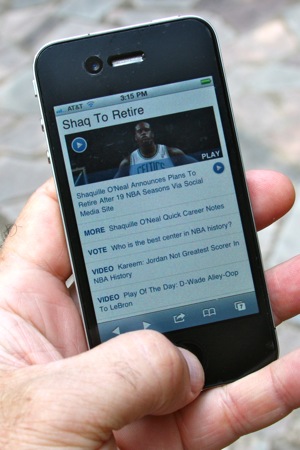 Today it’s not enough for your business to have a website. You must also have a mobile-friendly option. Mobile traffic continues to explode, and if your site is difficult to use, your customers will go elsewhere.
Apple alone has sold more than 187 million iOS devices (iPhone, iPad and iPod Touch). And Apple isn’t even the market leader. Today, Google’s Android is the fastest-growing mobile platform, activating 400,000 new devices every day.
You can check your website analytics to see how much mobile traffic you’re currently receiving, what devices are visiting and how long people are sticking around.
It doesn’t have to be a big job to make your site perform better for mobile traffic. While the specific steps you should take may vary, there are some things you can do that will make your site more useful to mobile visitors.
1. Choose text over visuals
Mobile visitors are more tactical than desktop visitors. They’re not just web surfing; they’re looking for something. They may even be nearby. So make sure you’ve provided the essential information they’re seeking: location, map, hours, email and phone number. Provide a clear description of who you are and what you do. For example, if you’re a restaurant, include a menu. Make sure your customer doesn’t have to wade through a bunch of screens to find it.
2. Presentation matters
Most of your content should be presented as text. Text is an under-rated element: it’s easy to create and edit, downloads quickly, and is easily indexed by search engines. For a mobile site, it also reformats for presentation to multiple devices.
Check your website navigation and make sure it works on mobile devices. If you have Flash-based elements on your site, get rid of them. Apple devices, more than 25 percent of the smartphone market, can’t view Flash. And, for the most part, neither can Google.
3. Get a mobile theme
The next step is to make sure your site is formatted for mobile delivery. If you use a content management system such as WordPress, this is easy. Just install a mobile theme like WPTouch or Carrington Mobile. Most popular content management systems like Joomla or Drupal also support mobile themes.
Don’t despair if your site isn’t easily themed for mobile. You may be able to make your site mobile-friendly through a service that reformats your navigation, images and text for mobile delivery. WireNode, MoFuse and Zinadoo offer three alternatives.
For the ultimate mobile experience, you may want to create a dedicated app. Note, though, that only three platforms – iPhone, Android and BlackBerry – have enough critical mass to support app development. If you’re considering this route, check your analytics to see which devices are visiting your site. You will likely have to develop for at least two platforms to accommodate most mobile visitors. And for the visitors who come from other devices – you’ll still need a mobile site for them.
4. Think like your customer
Always have a link to your home page on every page of your site. Provide a way to toggle in and out of the mobile site – some people will prefer the other version. And don’t feel like you have to “mobilize” every page of your site. Think about your customers’ needs and start with the most important pages.
Today there are more than 5,000 different mobile devices. Futurists call this the “splinternet” – a web in which seemingly everyone uses a different device and a different browser. Your online success begins and ends with delivering a meaningful experience to each visitor. No matter what device they’re using.

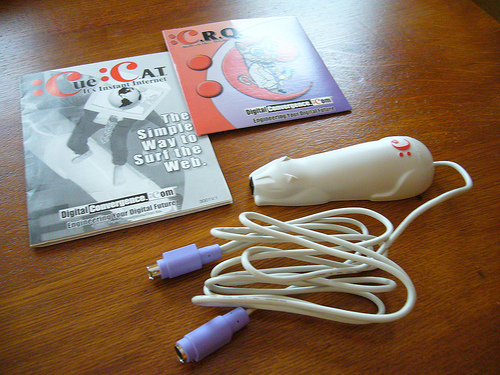
A barcode for the CueCat, circa 2000
Technologists have long talked about the “singularity,” the day when the machines can outthink us and surpass human intelligence. That day is a long way off. But we have reached another kind of singularity. In this event, our expectation is that the information we seek will be digital and easily available on demand. In the first Internet, our digital presence was a supplement to the dominant analog model. In the second iteration, a social layer moved many of our conversations online, alongside increasingly social content from mainstream publishers (think: Amazon book reviews, blog comments and “social” stores like eBay).
In the digital singularity (I dare not call it Internet 3.0) old-fashioned, grubby, in-real-life – ANALOG – assets are clamoring to join the fracas. And so far, it’s been a bumpy ride. Leading the way are web-friendly bar codes that push us to web sites when we take a picture of them with a mobile application. These have been deployed well (such as on product displays at stores like Best Buy; seriously, who can keep track of 40 different TV models without some help?) and poorly (almost every newspaper or magazine has an ad with a bar code, pushing you to some crummy commerical on a web page).
These bar codes are easy to create, print and share, but chances are they haven’t yet materially affected your daily life. If you don’t use a smart phone, they are out of your grasp. If you do, you must load the app before you point your device at the code. Sometimes it doesn’t work. It’s a reasonable technological approach, but still too tweako to become useful to the masses. We have yet to see the killer app that will make these codes part of our daily lives.
But if you would like to learn more about moving the analog world online, I highly recommend this post by Joshua Holland at Edelman Digital, which includes this slide deck (95 slides) from PSFK:
Further down the line, augmented reality holds more promise, though the technological base is pretty complicated for widespread adoption today. Layar, an augmented reality app for the iPhone and Android platforms, uses several layers of technology to deliver a locatin-based experience with a web overlay. It begins with the camera in your mobile device, which “looks” at the landscape in front of you. Next, the GPS in your device kicks in, associating the visual with coordinates in a Google map. Next, a “screen” of software is loaded, indicating points of interest on the map, floating on top of the image. Then some content flows onto your screen when you touch the points of interest. You might be led to a phone number, which you can dial with one touch, or some information about store hours, or the location of the nearest accessible entrance.
While it’s easy to use Layar, the different “layers” aren’t easy to find or load onto your mobile device, and there’s no critical mass of applications that will drive use of the software. Still, for niche use, this is promising – and powerful.
Today, the crush demand for digital content must be measured against the many hurdles that these new technologies face. We mustn’t become technological determinists. If we build it, there’s actually little chance that people will come. Failure is the norm. After all, we’ve done this before. During the first Internet boom, one hot technology was the CueCat: yes, a bar code reader to guide you to a web page. Of course, it was a colossal failure; Gizmodo voted it one of the worst inventions of the decade (2000s).
Wrote Brian Barrett:
“If you subscribed to a magazine in 2000, there was a decent chance you were sent a CueCat, and an even better chance you never used it. The CueCat was a barcode scanner that you plugged into your computer. The idea was that users would scan ads in magazines and thus be shepherded magically to the advertiser’s website. If it sounds like a needlessly cumbersome way to use the Internet, that’s because it is! Fortunately, the CueCat was put down for good in 2001.”
As you go through your day, watch for evidence of the “analog bridge”: technology that brings the analog world online in a meaningful way. The CueCat was ridiculously ahead of its time. After all, back then, going online meant booting a computer, firing up a modem and logging on to AOL. Today the barriers are much lower. And, with the digital singularity, there’s a pull – an expectation – that the conversation will be online.
What will be the killer app? Who is effectively using bar codes or augmented reality today?
Here is the slide deck from my presentation on 2/19/2011. Thanks including me in your conference!

photo courtesy mar is sea Y at Flickr.com via Creative Commons
Two years ago in Iran, and now in Egypt, digital communications have helped level oppression and censorship. You would think that blocking the Internet in an entire nation would silence people, but, like water seeking its own level, small leaks have turned into rivulets and have flowed back to the world at large. And we are watching – and listening.
Here is a chilling graphic, showing normal Internet communications in Egypt – then, on January 27, 2011 – almost nothing. The Egyptian government hit the kill switch. (See related article).
How do you communicate when communication is blocked? The key principles seem to be resourcefulness and redundancy. Lifehacker and the Wall St. Journal have documented how ordinary phones have become digital lifelines through good-old dialup service. So think twice before ditching your wireline service. Or your modem. Telecomix, through its Wiki We Rebuild has created resources dedicated to a free and uncensored Internet, including this page of resources for Egypt.
One of the marvelous things about Twitter is how it effortlessly jumps to and from the Internet and SMS networks. Another benefit of Twitter is the critical mass of people who use the service. If you communicate on Twitter, you can be confident someone will get your message.
Got hacker skills? Here’s how to repurpose old television satellite antennas to beam a Wi-Fi signal up to 125 miles.
If you’re more old school, you might want to jump back into analog technologies, including shortwave or ham radio, sneakernet, or good old face-to-face communication.
As our communication becomes more centralized on the Internet, you might ask yourself: what would you do in an emergency or natural disaster? How will you be resourceful? How are your communications channels redundant?

photo courtesy of Xurble at flickr.com, via Creative Commons
Where is the public relations field going in 2011? That’s the question that will be put to a panel convened by the Chicago chapter of the Public Relations Society of America. Here are a few things that are on my mind:
Technology: the “universal internet” is dying, and is being replaced by what Josh Bernoff calls the “splinternet.” Think about it: your amazon.com experience is different from mine. The site uses what it knows about us as consumers to deliver a tailored experience. And that’s good. We also expect to be able to access web content from our phones, our tablets, even our televisions. Our challenge is to be able to present our message – fluently, of course – where people expect to find it. Each channel, each mode, has its own set of rules and “superpowers.” So don’t expect to get by simply pushing your Tweets to Facebook. And be ready to face the technical hurdles necessary to reach your audience on the device of choice. Other technologies to watch: HTML5. Web content delivered to televisions. The rise of Android phones and tablets. Location-based services.
Trust: Edelman Trust research shows that trust is fragile, and in some cases, in decline. Moreover, our daily experience shows it. We’ve had it with lying politicians, polarizing “news” channels, and companies that tell us one thing and show us another. On the technical front, the very infrastructure of the web is shaky, as we contend with web beacons, Flash cookies and other tracking technology. Learn more about these technologies in a series at the Wall St. Journal, What They Know. While e-commerce is most immediately threatened, any technological development that undermines trust curtails the effectiveness of otherwise promising new channels of communication.
Attention: it’s getting noisy out there, and consequently it’s getting harder to actually reach people online. Overall, the best approach is to be findable online and to create compelling content. Apps are costly to develop and not yet universal – your iPhone app won’t play on an Android phone – yet offer a protected oasis for your message. When someone is in your app, you’ve got their full attention. When someone downloads your App, you know that person is in your tribe. Social sharing will continue to grow – look for increased sophistication on Facebook pages, and explosive growth of “expert” sites like Quora, Yahoo! Answers and Google Knol. A new class of influencers – some work for one employer, others are unaffiliated or have multiple affiliations – will gain increased attention, authority and trust, competing with and supplementing the mainstream media.
How to prepare students to thrive in this environment? Public relations fundamentals, such as campaign development, are as valid as ever. But we must increase our technological “vocabulary” and teach new tactics. In short, students must be classically trained, but also ready to play jazz.
What do you see as the major trends affecting public relations in 2011?
One year ago, the Federal Trade Commission updated its Guides Concerning the Use of Endorsements and Testimonials in Advertising, to go into effect on Dec. 1, 2009. The 81-page document identified three main updates to the Commission’s rules:
Of these three, the “material connections” guidelines are the subject of this article and two other related posts (see bottom of page). The release of these guidelines created a stir in the blogosphere and social media space, a largely unregulated melee of ideas, commerce and hucksterism. There was talk of $11,000 fines for bloggers who ran afoul of these regulations (not true).
What really happened?
The announcement of the new Guides generated lots of discussion amongst bloggers, in large part depending on their position in it. Established bloggers, for example, said the ruling would cut down on the “cloggers,” wanna-be influencers who were blogging just to get free products and services. Some said it was an important step forward that would improve the credibility of the blogosphere.
There was also plenty of criticism.
“Jumbo are the shrimp and deep are the highballs at most media events,” wrote Eric Felten in the Wall St. Journal. His point was that the mainstream media get all sorts of free product – from books to review to the best seats at sporting events. Why should bloggers be held to a higher standard?
Dan Gillmor found the effect of the ruling to be “unworkable,” noting the high volume of bloggers and predicting “full employment” for First Amendment lawyers. And many wrote of the First Amendment implications of the ruling. For example, Randall Rothenberg of the Interactive Advertising Bureau called it “Constitutionally dubious,” for its sharp distinction between online and offline media.
FTC actions
While the new Guides may eventually open the spectre of Big Government limiting free expression, so far the Commission’s actions are modest.
In January, 2010, Ann Taylor Loft invited 31 bloggers to see the new summer clothing line. The bloggers were encouraged to write about the new clothing, then submit their content to a public relations person in order to win a gift card. The value of the gift card was not revealed until after the submission. According to Jezebel.com, the note said:
Come take a sneak peak at LOFT’s summer 2010 collection before anyone else! … Bloggers who attend will receive a special gift, and those who post coverage from the event will be entered in a mystery gift card drawing where you can win up to $500 at LOFT!
Coverage from the bloggers was very positive, and only two of the 31 attendees disclosed the gift from Ann Taylor Loft.
The FTC’s response?
Upon careful review of this matter, we have determined to not recommend enforcement at this time.
The FTC slapped Ann Taylor Loft on the wrist, noting that this was a first-time occurrence, that the company had agreed to go over disclosure rules with bloggers in the future, and that the effect of the promotion was small. The takeaway: the advertiser has a responsibility to encourage the blogger to disclose.
The second FTC action resulted in a settlement with Reverb Communications, a PR firm. Reverb had several clients who published games in Apple’s App Store. Reverb employees were found to have written positive reviews by the FTC. The FTC’s position was that they were “shill” reviews; Reverb contended that the employees bought the games with their own money and wrote the reviews as individuals. Here are some of the reviews, as reported by the FTC:
The complaint was settled by removal of the reviews from the App Store. Reverb owner Tracie Snitker said:
The FTC has continuously made statements that the reviews are ‘fake reviews,’ something we question … If a person plays the game and posts one review based on their own opinion about the game should that be constituted as ‘fake?’ The FTC should evaluate if personal posts [from] these employees justifies this type of time, money, and investigation. It’s become apparent to Reverb that this disagreement with the FTC is being used to communicate their new posting policy.
FTC attorney Stacey Ferguson told CNET:
We’re most concerned about the disclosure of the connection … so whether or not the employee actually did love the game or not, that wasn’t really of consequence to us. We want them to disclose that they did have an affiliation with Reverb and the client when they’re making those endorsements.
Read more about the FTC disclosure guides: